
· The Nodly team
Massage gun vs neck massager: not two versions of the same thing
Both are motorised, and there the resemblance ends. The difference decides which is still in use in six weeks.
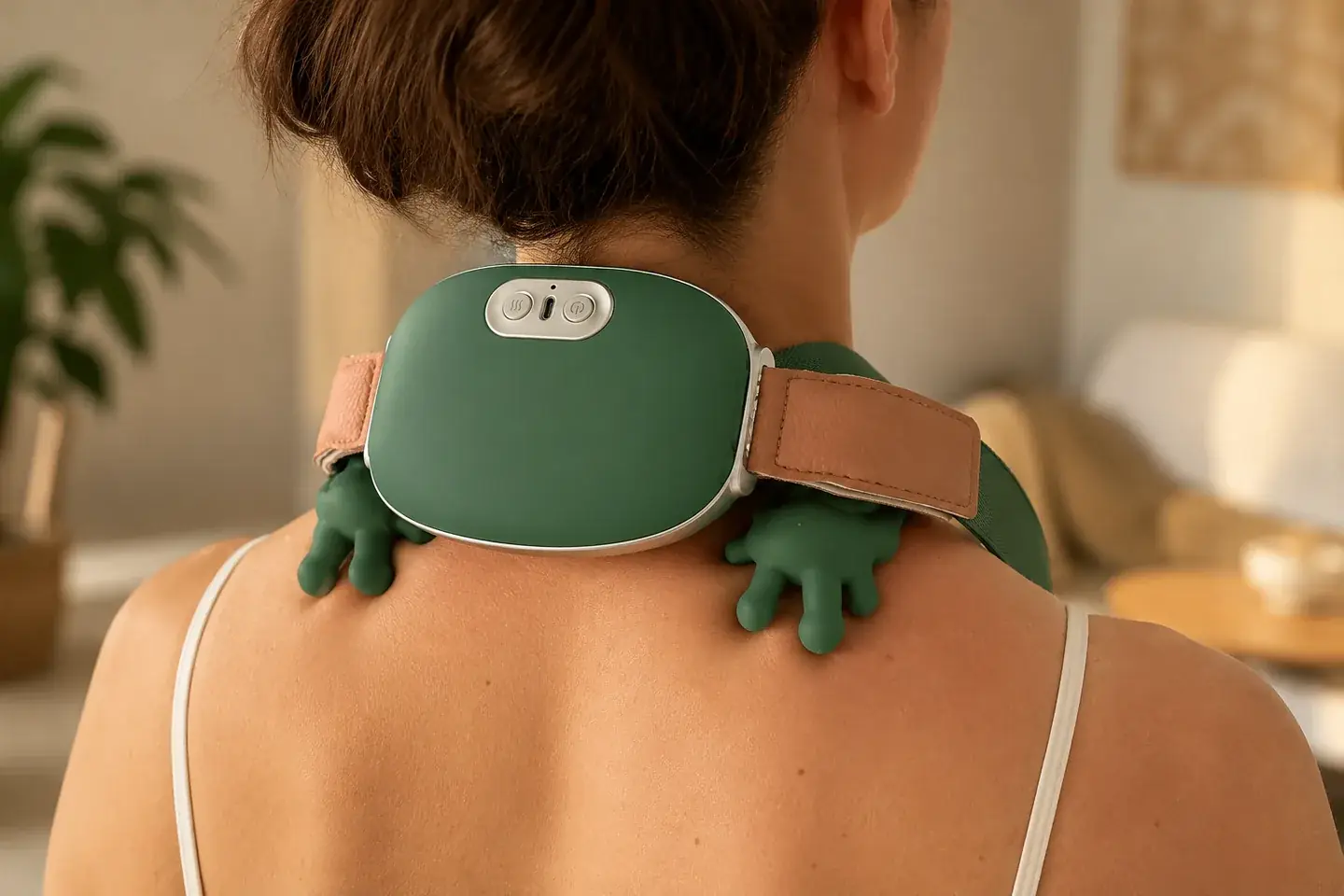
Massage gun vs neck massager: two mechanisms, and the gap is not a matter of degree
Percussion is an impact. A head is driven against the tissue and pulled back, over and over, so the energy arrives as short blows wherever the hand holds it. Kneading is a different event: a contact point presses into the muscle, stays there while the tissue gives, and releases before moving on. One drums. The other reproduces what a thumb does.
Neither is a milder version of the other. A third mechanism, vibration, shakes a housing instead, and the way to tell the three apart from a photograph is in what shiatsu means on a box. Ours carries two heads shaped as hands, five food-grade silicone fingers each: ten contact points across the band rather than one under a barrel.
What each one asks of you while it runs
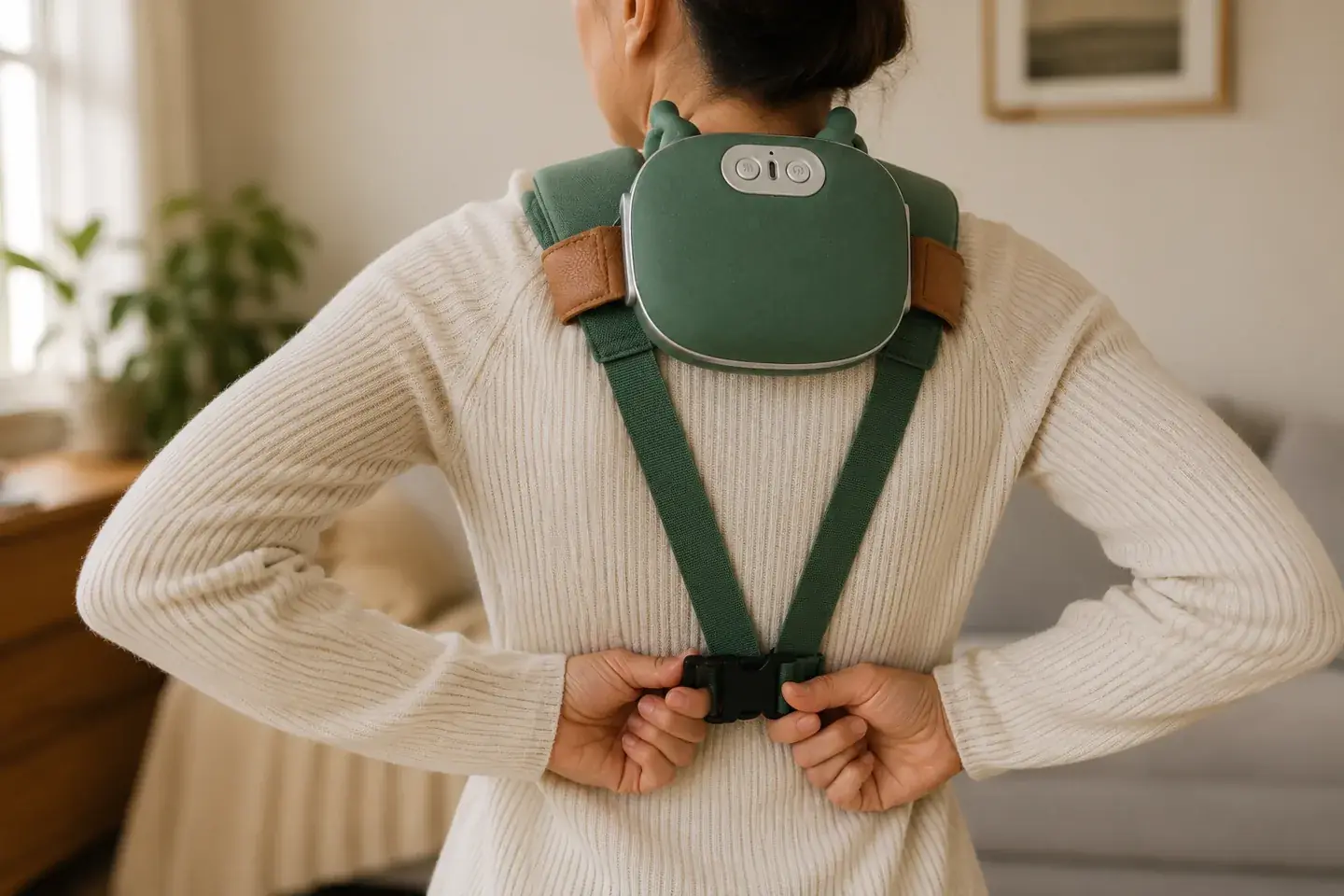
A gun has to be held, aimed — the head covers a small area, and the muscle you want is not always where your hand thinks it is — and pushed, so the arm holding it works for as long as the motor does.
Pointing one at your own neck compounds all three: the arm goes up and back behind your head, the shoulder stays raised, and you cannot see the target — static work for the muscle you sat down to release, which is why the hands-free question comes second in our six. Ours buckles behind you, and then your hands do nothing.
| Massage gun | Shoulder-worn massager (ours) | |
|---|---|---|
| What the head does | Strikes and retracts against the tissue | Presses in, holds, releases |
| What your hands do | Hold it, aim it, push it in | Nothing — it buckles behind you |
| How firmness is set | By how hard you push | By strap tension, on top of three modes |
| Shape of the target | One point at a time, anywhere you can reach | A band across neck, trapezius and shoulders |
| Reaching your own neck | An arm raised behind your head throughout | It sits there; both hands stay down |
| When the session ends | When you decide to stop | Ten minutes, then it shuts off on its own |
Neck massager vs massage gun: the zone each one actually reaches
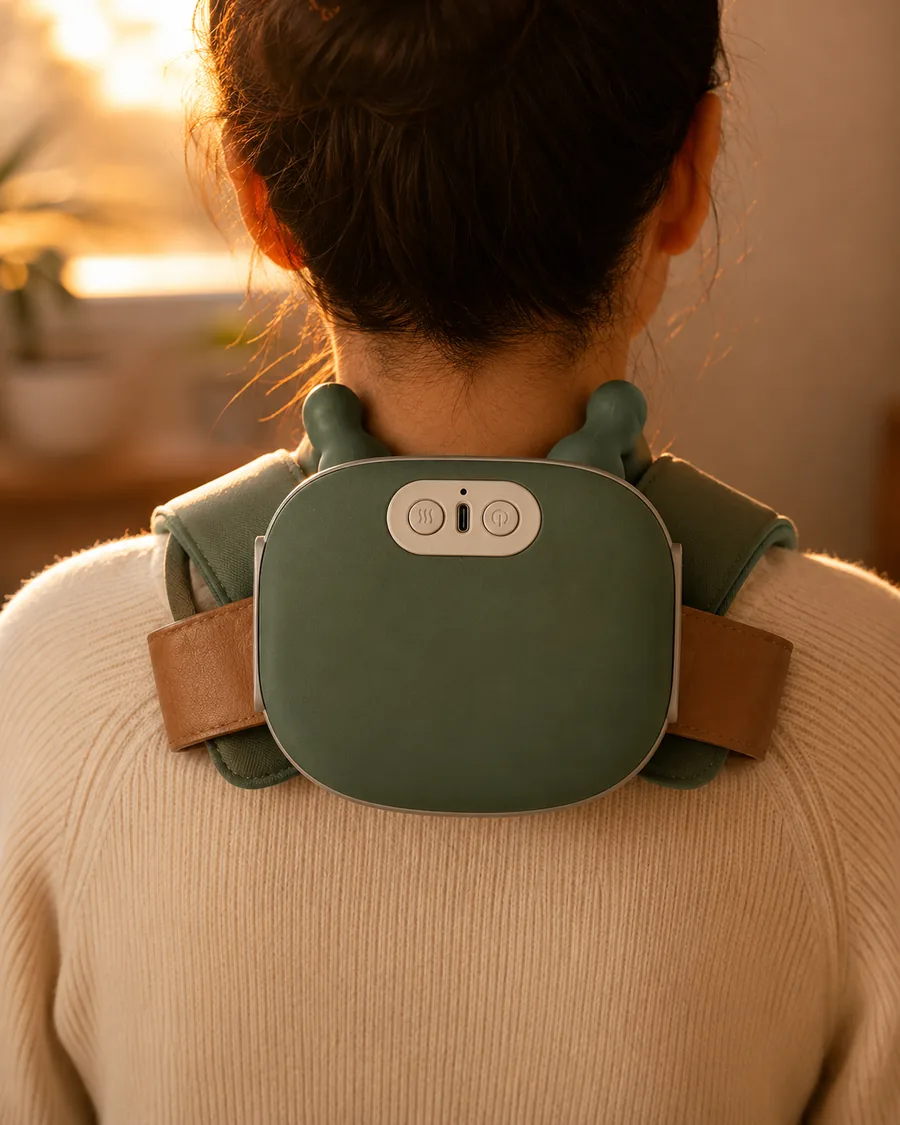
Ours reaches a band: neck, trapezius, shoulders, waist and calves. It does not reach the upper back, because the arms do not open wide enough outwards, and that sits on the product page rather than in small print; the full map is on the back and neck page. A gun reaches wherever you can point it, one spot at a time.
Reach and coverage are separate things. The band that aches after a screen day runs from the base of the skull to the points of both shoulders, and it aches along its whole length. One head treats that as a series of stops; two heads carrying ten fingers sit across it at once, which is why positioning is most of the technique.
What a gun's shape is built for
It earns its keep on the big muscles of the legs and hips, where the mass is deep, the area is large, and the arm holding the device is not the arm being treated. It is also the tool for one precise spot rather than a band: you put the head where you want it and hold it there, and someone else can use it on you.
None of that describes a stiff neck at the end of a working day: a band, on both sides, on muscle you cannot see, when the arm that would hold the tool has been at a keyboard all day.
At a desk, and on the sofa afterwards
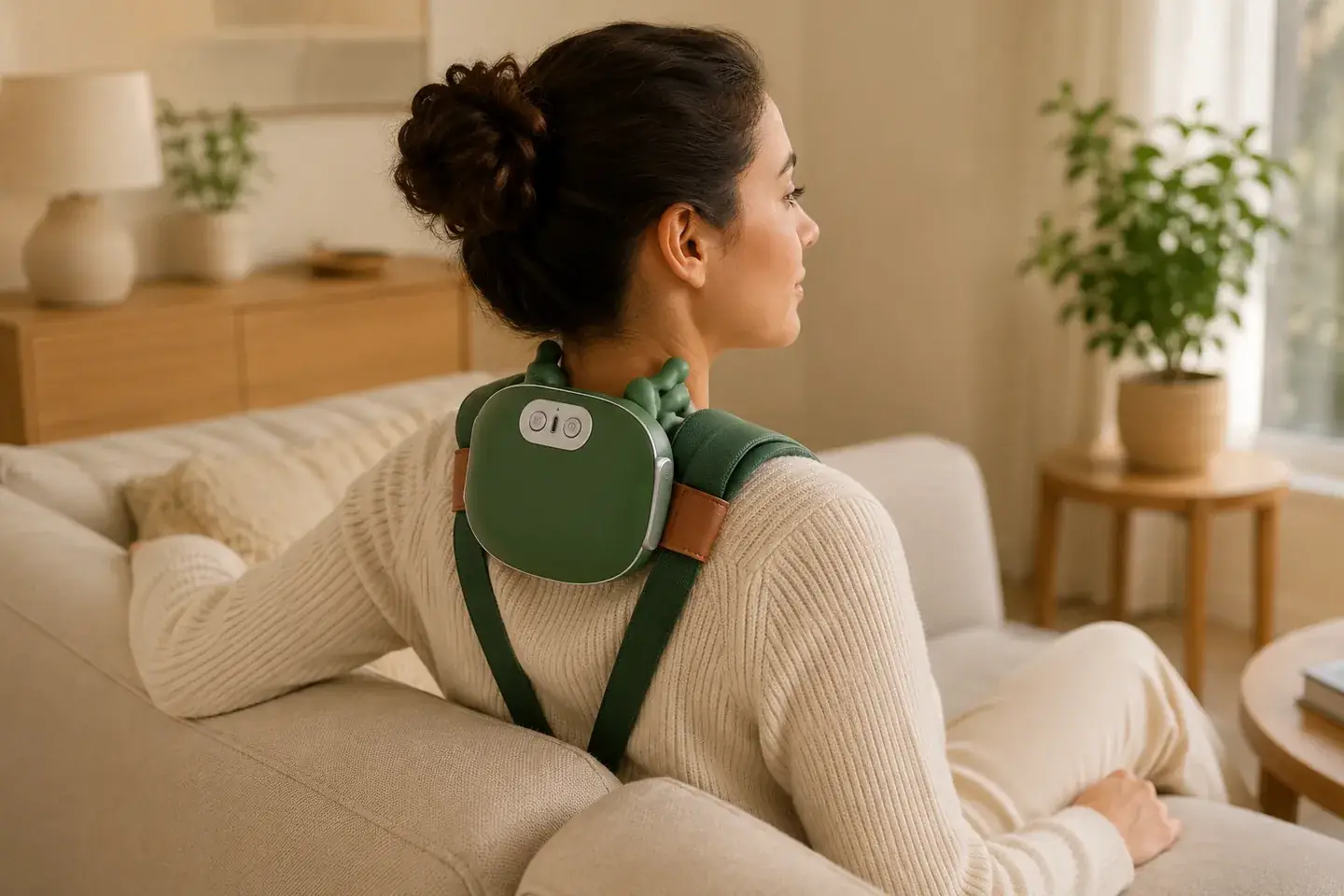
At a desk, the question is whether the session costs you the desk. Ours buckles on and runs while you read something: ten minutes, then it stops by itself. It is cordless, and at 1.7 lb (760 g) it travels in a bag. The routine that goes with it is in the desk guide.
Reclined against a sofa, a held device sits at an angle that undoes the reclining; ours stays where it was buckled, and one buyer described it as two hands massaging the neck. Set the mode and the heat before you settle back: reaching a control resting on your own neck means raising an arm.
The noise, without a decibel figure either way
We have not measured either device in decibels, so neither figure appears here. A head that strikes and returns makes a repeated knock, because that is the motion doing its job. A head that presses and releases makes a low continuous sound instead — on ours, a brushless motor working under the strap and the padding. Of the buyers who have written to us, none raises it.
The part that is not a matter of preference
A thigh and a neck are not interchangeable places to put a motor, and the neck is the one where the instructions matter: follow the manual that came with whatever you use there, rather than a rule of thumb from a website. Ours states plainly that it is a personal care item and cannot replace medication or medical equipment, and the places to keep it away from are set out in the safety guide, taken from that manual.
The threshold for stopping and asking someone is short. Pain that is sharp rather than firm, pain that radiates down an arm, pins and needles, weakness in a hand, or anything following a fall is a question for a clinician. So is using any massage device at all if you are pregnant, have a pacemaker or an implant, or are being treated for a neck condition.
Massage gun vs neck massager: one criterion, if you keep only one
Ask what the tightness is shaped like. A point on a large muscle is a job for something you aim. A band across the neck and both shoulders at the end of a day is a job for something that sits on it: pressing rather than striking, across ten contact points, for ten minutes that end on their own.
That second shape is the common one. In Great Britain the Health and Safety Executive recorded 211,000 work-related musculoskeletal cases principally affecting the upper limbs or the neck in 2024/25, out of 511,000 in total — 41%, in one band, on the part of the body you cannot comfortably point anything at.
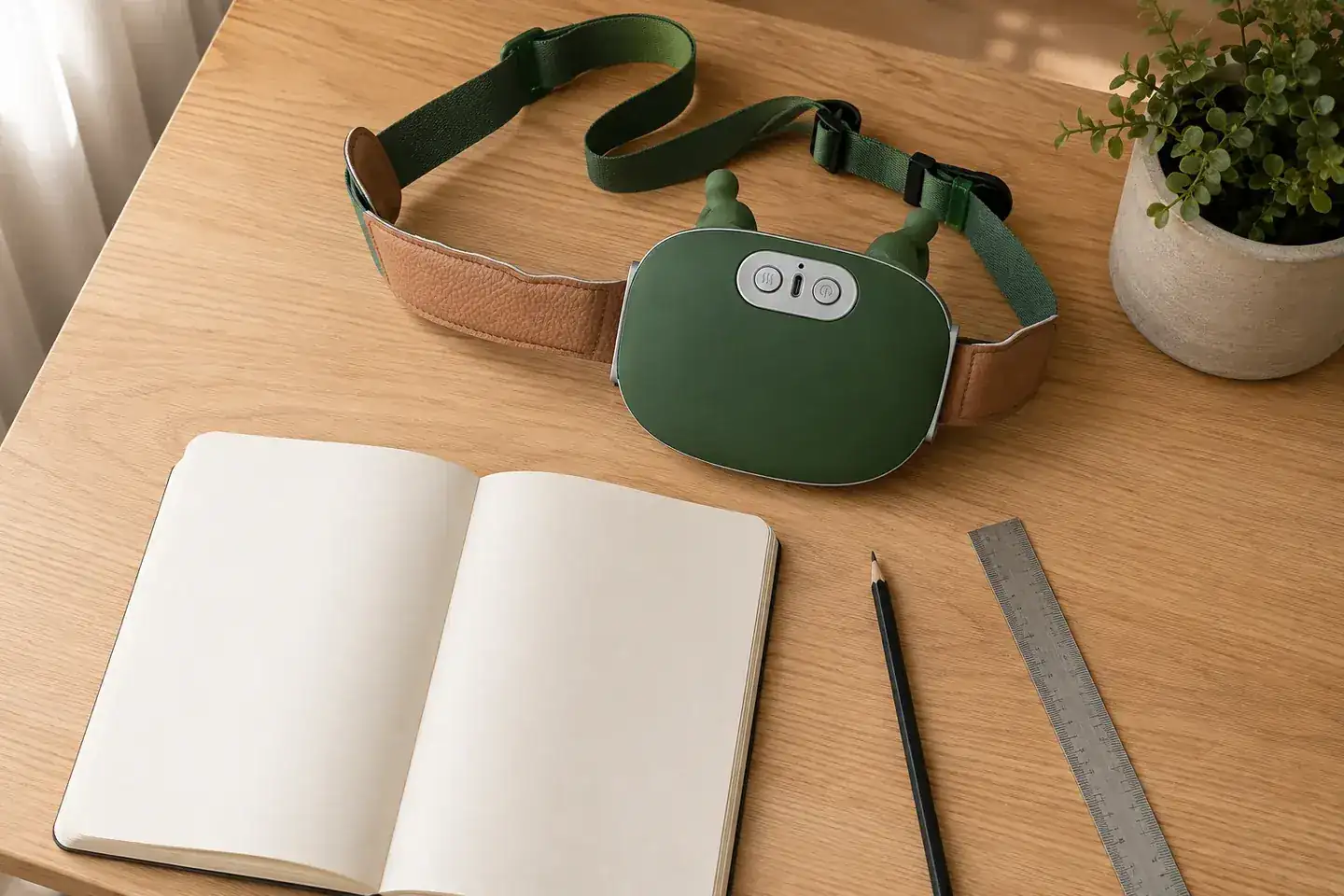
Ours is built for that band: three modes, two heat levels given in the manual as 42 °C (108 °F) and 45 °C (113 °F), and a ten-minute session that ends on its own. Thirty days to change your mind, return shipping on us.